Orchestral Materials Checklist

1. Score Format
1.1. Dimensions


  • An orchestral score must be in 11 x 17 format (portrait orientation).
    • The staves must be large enough to be easily read by the conductor (who is standing).
    • Use only one system per page.
    • Aim for a maximum of six measures per page.


  • A string ensemble score must be in 8.5 x 11 format (portrait orientation).
    • The staves must be large enough to be easily read by the conductor (who is standing).
    • Use two systems per page.
    • Aim for a maximum of six measures per system.


  • Individual parts must be in 8.5 x 11 format (portrait orientation).


1.2. Staves in the Score


  • Woodwinds:
    • For classical orchestra and symphonic orchestra: Each woodwind instrument must be placed on its own staff. e.g.: Flute I and Flute II must each have their own staff.
    • For full orchestra, arrange the woodwinds as follow:
      • Flutes I-II
      • Flute III (or Piccolo / Alto Flute)
      • Oboes I-II
      • Oboe III (or English Horn)
      • Clarinets I-II in B♭ or A
      • Clarinet III in B♭ or A (or Bass Clarinet)
      • Bassoons I-II
      • Bassoon III (or Contrabassoon)


  • Arrange brass staves in the following order:
    • Horn I and II
    • Horn III and IV
    • Trumpet I and II
    • Tenor Trombone I and II
    • Bass Trombone
    • Tuba


  • Use one staff for each percussionist (not one staff for each percussion instrument). This way, each staff corresponds to the part of a single percussionist.
2. Instrument Naming
2.1. I and II


  • Write “I” and “II” (Roman numerals) next to the names of wind instruments that have multiple players. e.g.: “Flute I”, “Flute II”, “Trumpet in C I-II”. The same applies when abbreviations are used: e.g.: “Fl. I”, “Fl. II”, “Tpt. I-II”. (Check page 2 of your score to make sure this information is displayed correctly.)


  • Although two instruments may share the same staff in the score, each instrument must have its own individual part. e.g.: even if Trumpet I and II are written on the same staff in the score, the Trumpet I part must not display the notes played by Trumpet II (and vice versa).


2.2. Transposing Instruments


  • Specify the key/tonality with the instrument name when dealing with a transposing instrument. e.g.: “Horn in F”.


  • For Trumpet in C, it is important to specify the instrument (although it is not a transposing instrument) in order to clearly distinguish it from Trumpet in B♭.
    e.g.: “Trumpet in C”.


2.3. Percussions


  • The staff name must be Percussion (not the name of the percussion instrument).
    If the score contains more than one percussion part, add a number for each part: e.g.: “Percussion I” and “Percussion II”.


  • Whenever a percussion instrument is used, always specify it by writing its name in a box above the relevant passage.


  • If a cymbal is used, specify whether it is a cymbal on stand or a pair of crash cymbals.


  • On the first page of a percussion part (top left), specify all percussion instruments that will be used in that part. This allows the percussionist to quickly confirm that all required instruments are available.
3. Layout
3.1. Score


  • The first page must display the following information:
    • The composer’s name, at the top right.
    • The title of the work preceded by the performance order number, centered on the page. If the performance order has not yet been determined, simply place “00” before the title as a place holder.
    • If a click track will be used during the recording session: The indication “Two measures of metronome before measure 1”, on the left side.
    • When measure 1 is preceded by pick up, specify the measure number at measure 1. If an instrument does not play during the pick up, it is important that the rest symbol has the same duration as the pick up.

Example:

  • The space between instrument families (e.g.: woodwinds and brass) must be greater than the space between staves within the same family (e.g.: flutes and oboes).


  • Unless a long musical passage uses only a small group of instruments, avoid hiding empty staves. It is easier to follow the score when empty staves remain visible (because instrument staves remain aligned from page to page).


  • The first staff of each instrument family must display measure numbers:
    e.g.: flute, horn, and violin I. (Make sure measure numbers are not too small.)


  • Do not include a “copyright” notice, in order to allow the orchestra to print the score.


3.2. Individual Parts


  • The first page must display the following information:
    • The composer’s name (top right).
    • The title of the work preceded by the performance order number (centered).
    • If a click track will be used during the recording session: The indication “Two measures of metronome before measure 1”, on the left side.


  • If an individual part contains more than one page, make sure that the page ends with measures of rest, leaving enough time for the musician to turn the page.


  • Do not include a “copyright” notice, in order to allow the orchestra to print the part.
  • Make sure there is enough space between each staff/system.


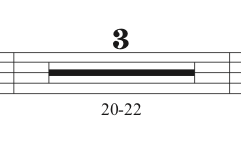
  • Use multi-measure rests whenever there is more than one consecutive measure of rest. The measure numbers included in the multi-measure rest must be written below it.

Example:

4. Grouping
4.1. Strings


  • Solo vs. Tutti
    • Indicate Solo when only one musician from a section should play.
      e.g.: a cello solo.
    • Indicate Tutti after a solo passage when the entire section should play.
      e.g.: the entire cello section plays after a cello solo.

If a solo player performs a part at the same time as the rest of the section, it is preferable to write these two parts on separate staves: one staff for the soloist (with the indication Solo), another staff for the remaining section (the indication Gli Altri” may be used). When creating the corresponding individual part, make sure both staves are included.


  • Divisi vs. Unison
    • Indicate Div. when a string section must divide to play different notes.
    • Indicate Unis. after a divisi passage when the entire section plays the same notes.
    • Indicate Non Div. when you want to ensure that a chord is played as double stops (rather than divided).


4.2. Winds


  • a2 vs. I. or II.
    • In the score, indicate a2 when two instruments play in unison on the same staff.
      e.g.: when two trumpets, written on the same staff, play the same note.
      In the corresponding individual parts, make sure that the notes played by both musicians are present, but do not include the symbol “a2”.
      (Note: the indication “a1” does not exist.)
    • In the score, if a staff contains two parts and only one of them plays, two options are possible:
      • Indicate I.” or “II.”
        e.g.: to specify whether Flute I or Flute II should play the notes.
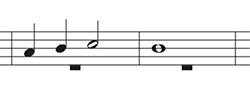
      • Write rests in the voice that is not playing, e.g:
5. Rehearsal Letters
  • Add as many rehearsal letters as necessary.


  • There must not be a rehearsal letter at measure 1.


  • Rehearsal letters must not obscure measure numbers.


  • When possible, place the measure containing the rehearsal letter at the beginning of a page.
6. Repetition of Sections and Articulations
  • Avoid using repeat barlines. Prefer writing repeated passages in full.


  • Avoid writing “simile”. Instead, write out the complete articulations involved.


  • If the recorded music is intended to loop in a video game:
    • Avoid using repeat signs in the score.
    • Avoid writing the pre-entry at the end of the score (the pre-entry should only appear at the beginning of the score).
7. Key Signature and Accidentals
  • Scores must be written in transposed notation (i.e., NOT in concert pitch).


  • Unless the work is clearly tonal, the scores must not contain key signatures, either for non-transposing instruments or transposing instruments. All accidentals must be written on every altered note.


  • If the work was composed in concert pitch, carefully check the accidentals of instruments after converting the score to transposed notation. Make enharmonic changes when they improve readability. e.g.: changing a double-sharp C to a D.


  • Add courtesy accidentals when necessary.


  • Use double barlines only in the following cases:
    • To indicate a key signature change
    • To indicate a meter change
    • To indicate a tempo change
8. Articulations, Dynamics, and Playing Techniques
  • Verify that the tempo and tempo changes are clearly indicated.


  • Verify the dynamics of each instrument (and add reminders when necessary). e.g.:
    • Be consistent with the dynamics of instruments belonging to the same plane of sound.
    • Do not compensate for an unsuitable register by changing the dynamic level.
    • Avoid long dynamic changes between closely related dynamics.
      e.g.: avoid a long crescendo from mf to f.


  • Verify the playing technique of each instrument (and add reminders when necessary). e.g.:
    • pizz. vs. arco.
    • sul ponticello vs. naturale.


  • Verify the phrasing and articulations of each instrument. e.g.: slurs, staccato, accents, etc.
    • Be consistent in articulations when two instruments play the same melody and/or belong to the same plane of sound (unless, for example, a long phrase played by a wind instrument cannot be performed within a single bow stroke by a string instrument).


  • Do not write bowings (e.g.: up-bow and down-bow markings). Only write slurs. The principal violinist will be responsible for adding bowings.
9. Meter

For passages intended to be played with a swing rhythm, use a compound meter (e.g.: 6/8). Avoid writing the passage in a simple meter with the indication “swing”.

10. Instrument-Specific Considerations
10.1. Horns


Horn I and II must be written on the same staff. Horn III and IV must be written on the same staff. However, Horn II must have a higher range than Horn III. For more information regarding horn grouping in the conductor’s score, see:
Horn Wars – Scoring 1/2, 3/4 vs. 1/3, 2/4


10.2. Harp


  • Specify the harp pedal tuning and all pedal changes. Here is an example of a simple way to notate the harp pedals for a D major scale:
    D C# B / E F# G A
    A modulation to A major would be indicated as:
    D C# B / E F# G# A


10.3. Percussions


  • If percussion changes are required, make sure the percussionist has enough time to move from one instrument to another.


  • Use the tremolo symbol to indicate rolls. e.g.: a snare drum roll.


  • For percussion instruments without sustain (e.g.: snare drum), do not use rhythmic values longer than a quarter note. e.g.: do not write half notes or whole notes. For compound meters (e.g.: 6/8 or 9/8), dotted quarter notes may be used.


10.4. Timpani


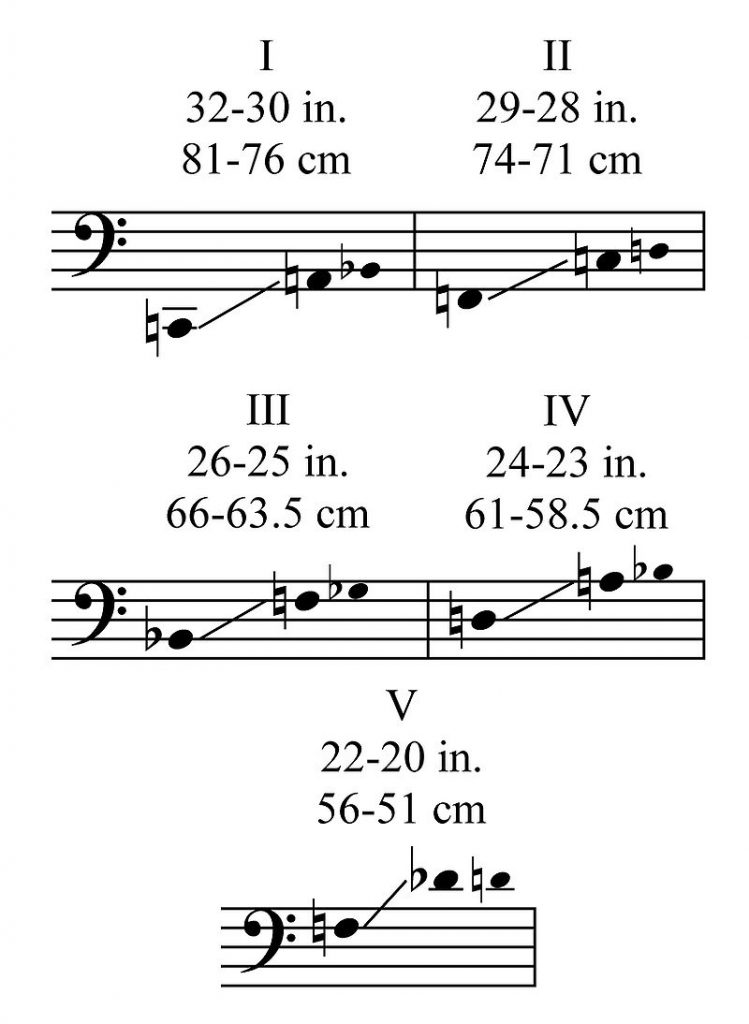
  • Ensure that the timpani part can always be distributed among the available timpani. A professional orchestra should generally have timpani I through IV:
  • Normally, the timpanist can change tuning throughout the piece. However, for a very short piece, it’s safer if the timpanist maintain the same tuning from beginning to end. In which case:
    • Specify the timpani tuning above the timpani staff.
      e.g.: I = F, II = A, III = C, IV = F.
    • When a timpani cannot play the bass note, it may play another note from the chord. If it cannot play a chord tone, it is preferable to choose at least one consonant note.


10.5. Strings


  • Make sure that notes intended to be played as natural or artificial harmonics are correctly identified.mFor reference, see:

Basic String Writing – Harmonics

To ensure that harmonic notes are easily playable, favor artificial fourth harmonics (see 9:46 in the video).


10.6. Unison Doubling
  • “Solo” sound vs. “ensemble” sound: favor melodies performed either by a soloist or by an ensemble (minimum three musicians).


  • Avoid melodies played by only two musicians, in order to prevent an unstable or “out-of-tune” sounding quality.
11. Assembly
11.1. Score


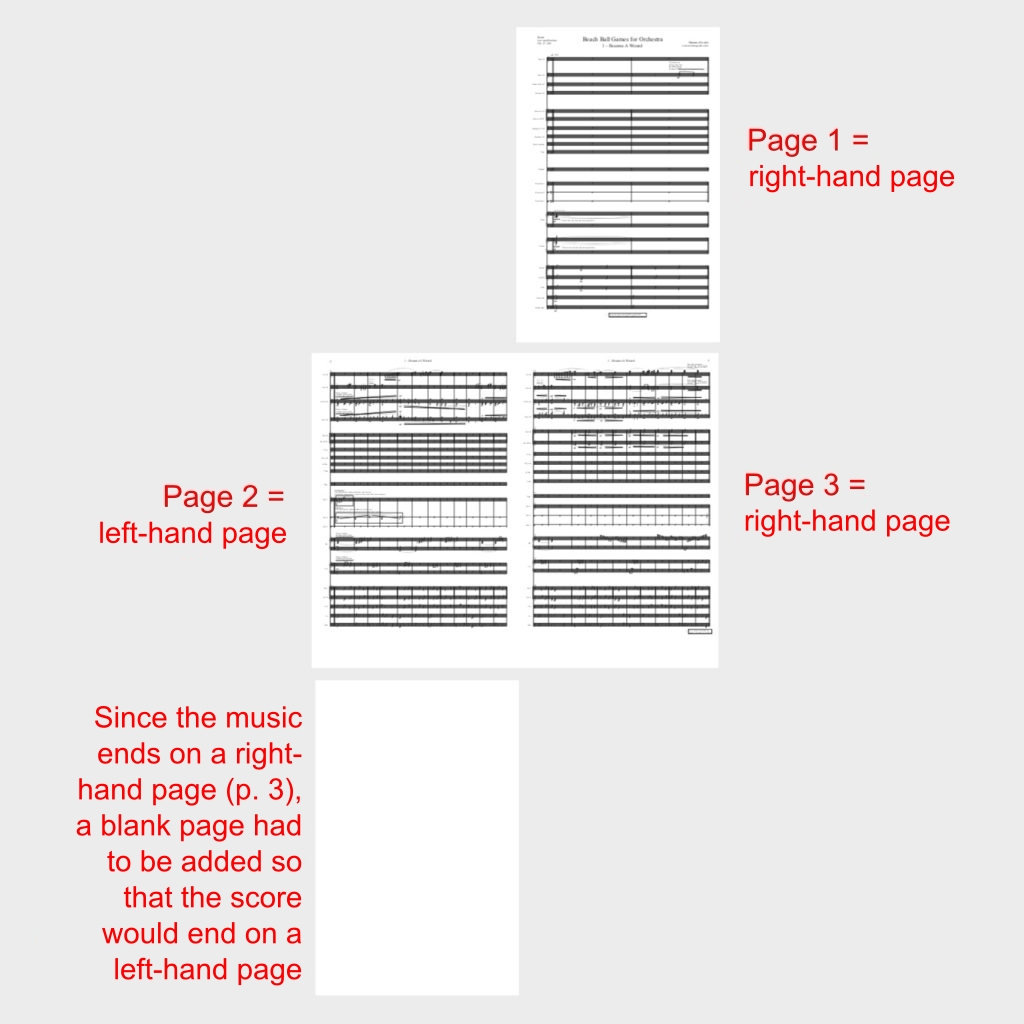
  • The score must begin on a right-hand page and end on a left-hand page. If necessary, add a blank page at the end of the score.

This way, when all scores from all works are merged together, each work will begin on a right-hand page.

Example:


11.2. Individual Parts


  • Each individual part must be a single PDF file. (e.g.: Violin I and Violin II parts must be two separate PDF files.)


  • If a part exceeds one page, place the appropriate indication (in bold and underlined) in the bottom-left corner of the first page:
    • Bind as a left-hand page
    • Bind as a right-hand page


11.3. Tacet Parts


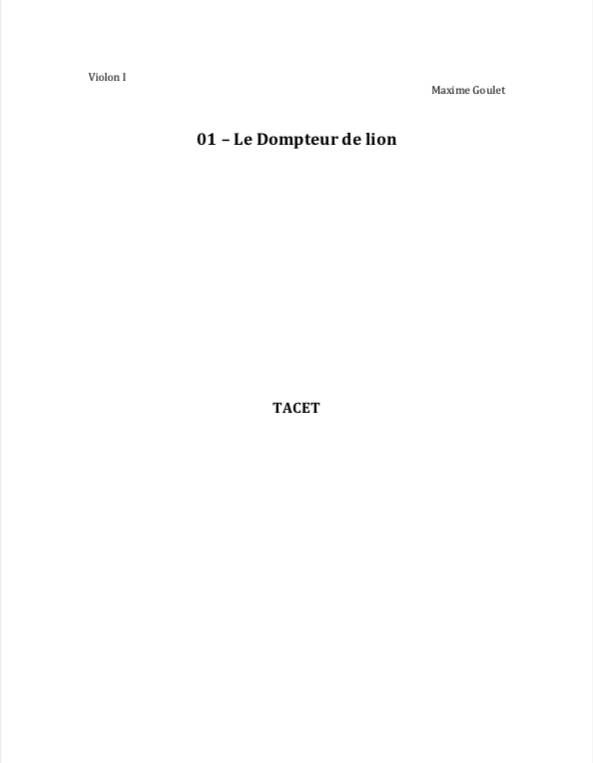
  • If you do not use all available orchestra instruments in your piece, create a “tacet” page for each instrument that does not play. This page must include: the title of the work (preceded by the performance order number), the composer’s name, the name of the instrument/part, the indication “tacet”. Example:
12. File Naming
12.1. Score

The PDF file name of the score must follow this format:

[Performance order number] – [Composer name] – [#Score]

Example: 01 – Maxime Goulet – #Score.pdf

There must be a “#” before the word “Score”. This ensures that the score file appears at the top of the file list in your folder.


12.2. Individual Parts

The PDF files for individual parts must follow this format:

[Performance order number] – [Composer name] – [Instrument]

Example: 01 – Maxime Goulet – Flute I.pdf

Instrument names must be written in English (not Italian).


12.3. Mockup

The audio file of the orchestral mockup must be in MP3 format.

The audio file must be named as follows:

[Performance order number] – [Composer name] – [#Simulation]

Example: 01 – Maxime Goulet – #Simulation


12.4. Click Track

If a click track is required, the audio file of the click track must comply with the requirements detailed on this page:

https://edu.maximegoulet.com/click-track-midi/

The click track audio file must be named as follows:

[Performance order number] – [Composer name] – [#Clicktrack]

Example: 01 – Maxime Goulet – #Clicktrack


12.5. Tempo Map

If a tempo map is required, the MIDI tempo map file must comply with the requirements detailed on this page:

https://edu.maximegoulet.com/click-track-midi/

The MIDI tempo map file must be named as follows:

[Performance order number] – [Composer name] – [#TempoMap]

Example: 01 – Maxime Goulet – #TempoMap


12.6. Folder Structure

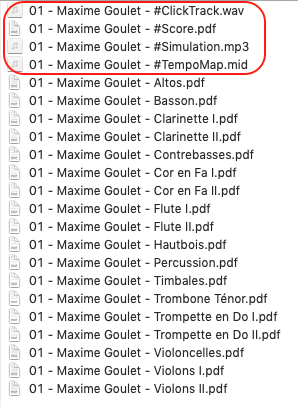
Your folder containing all files should look like this, with the four files beginning with “#” appearing at the top of the list: